The Polybius Square, also known as the Polybius Checkerboard, is a simple yet effective method of encryption that has been around for centuries. Conceived by the Greek historian and scholar Polybius around the 2nd century BC, this cipher allows you to transform plain text into a numerical code, adding a layer of secrecy to your messages.
While not suitable for top-secret government communications in the modern era, the Polybius Square offers an excellent introduction to the world of cryptography and can be a fun way to exchange encrypted messages with friends. Its simplicity makes it easy to learn and use, while still providing a basic understanding of encoding and decoding techniques. Think of it as your first step into more complex ciphers and encryption methods.
This guide will walk you through the process of creating and using a Polybius Square, allowing you to encrypt and decrypt messages with confidence. We'll cover everything from constructing the square to encoding and decoding your messages, along with tips for increasing its security.
Step 1: Constructing the Polybius Square
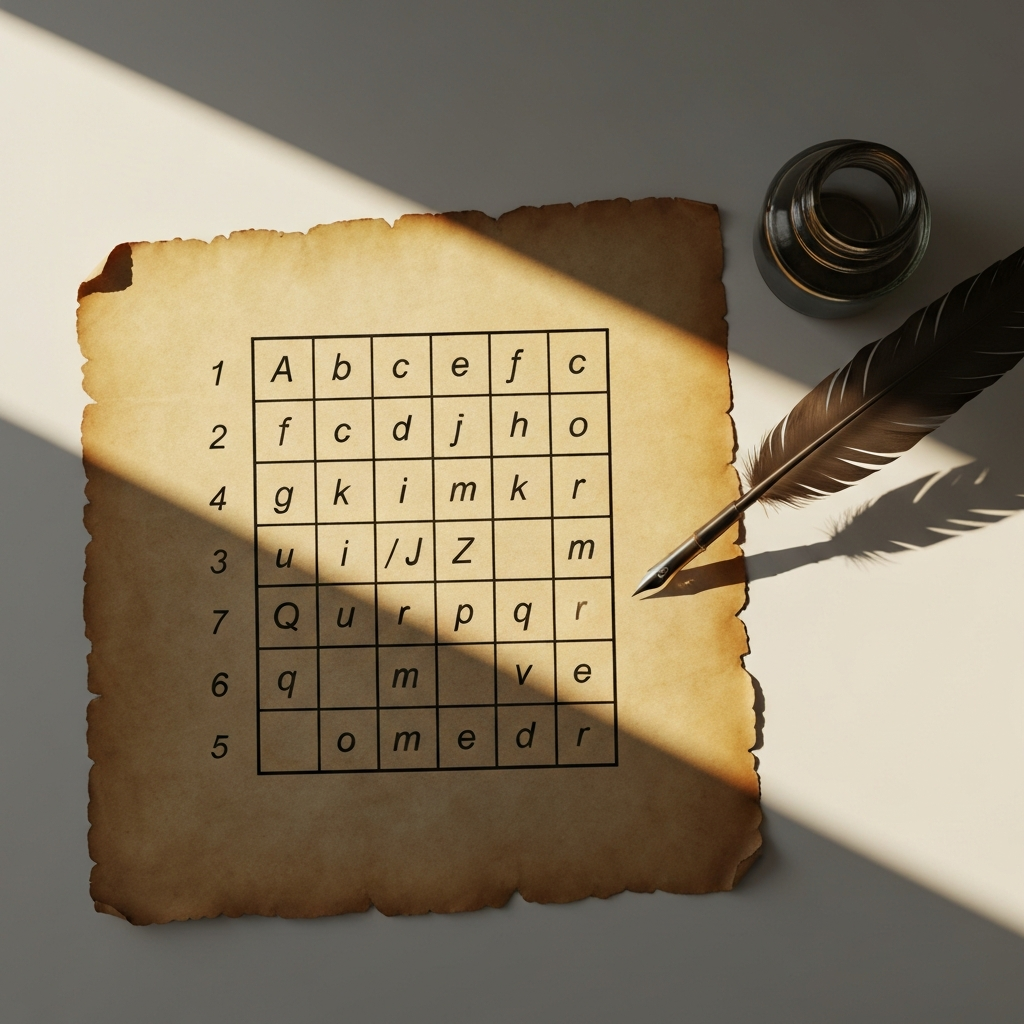
The foundation of the Polybius cipher is the square itself. To create a standard Polybius Square, draw a 5x5 grid. Label the rows and columns with the numbers 1 through 5. The size of the square can be adjusted based on your needs and alphabet, but a 5x5 grid is most common for the English alphabet. Fill the grid with the letters of the alphabet, typically in alphabetical order. Since the English alphabet has 26 letters and the grid only has 25 spaces, the letters 'I' and 'J' are usually combined into a single cell. This means that both 'I' and 'J' will be represented by the same numerical coordinates.

Step 2: Filling the Square with Letters
Now that you have your grid, it's time to populate it with the letters of the alphabet. Starting from the top-left corner, fill each cell sequentially with the letters of the alphabet, combining 'I' and 'J' into one cell. So, the first row would contain A, B, C, D, and E. The second row would contain F, G, H, I/J, and K, and so on. Remember to either omit a rarely used letter or combine I/J if you have too many characters. This arrangement creates a simple mapping between letters and their numerical coordinates, which will be used for encryption and decryption.
Step 3: Encoding Your Message
With your Polybius Square constructed, you can begin encoding your message. For each letter in your message, locate it within the square. Note the row and column number of that letter; these two numbers become the cipher text representation of the original letter. Replace each letter with its corresponding row and column number. For example, if 'A' is in the first row, first column, it would be represented as '11'. Continue this process for the entire message, separating the number pairs for clarity (e.g., with spaces or other delimiters).

Step 4: Decoding the Encrypted Message
Decoding the encrypted message is the reverse of the encoding process. Use your Polybius Square and the encrypted number pairs to reveal the original letters. For each number pair, the first number represents the row, and the second number represents the column. Find the cell at the intersection of that row and column to find the corresponding letter. If you combined 'I' and 'J', you'll need to consider the context to determine which letter was originally intended. Combine these letters in order to reconstruct the original message.

Step 5: Introducing a Keyword for Increased Security (Optional)
To make your Polybius Square cipher more secure, consider incorporating a keyword. Write the keyword at the beginning of the square, omitting any repeated letters. This rearranges the order of the letters, making it more difficult for someone to crack the code without knowing the keyword. After writing the keyword, continue filling the square with the remaining letters of the alphabet in their usual order. For example, if your keyword is "SECRET", the square would start with S, E, C, R, T, followed by the remaining letters of the alphabet in order (omitting S, E, C, R, and T). This modified square is then used for encoding and decoding messages.
Pro Tips for Enhanced Security
- Mix up the letters within the square randomly instead of just using a keyword.
- Use different symbols or characters instead of numbers for representing rows and columns.
- Use the Polybius Square in combination with another cipher for double encryption.
- Change the Polybius Square arrangement frequently for ongoing communication.
Common Mistakes to Avoid
- Forgetting to share the Polybius Square configuration with the intended recipient.
- Failing to account for the combined 'I/J' cell during decoding.
- Using a Polybius Square that is too simple or predictable.
- Not considering context when deciphering ambiguous letters.
FAQ Section
- Is the Polybius Square Cipher secure?
- The Polybius Square is a relatively simple cipher and is not considered highly secure, especially against modern cryptanalysis techniques. It is more suitable for recreational use or simple obfuscation.
- Can I use the Polybius Square with languages other than English?
- Yes, you can adapt the Polybius Square to any language by adjusting the size of the square to accommodate the number of letters in the alphabet. Remember to combine or omit letters if necessary to fit the grid.
- How can I make the Polybius Square more difficult to crack?
- You can increase the complexity by using a keyword, randomly arranging the letters, using symbols instead of numbers, or combining it with another cipher.
Tools or Materials Required
- Paper or a computer for creating the grid.
- Pen or pencil.
- A method for sharing the Polybius Square with the recipient (e.g., physical copy, image, secure online communication).
In conclusion, the Polybius Square is a fascinating entry point into the world of cryptography. While not the most secure method, its simplicity makes it a valuable tool for understanding basic encryption concepts and enjoying lighthearted secret communication. By following this guide, you can confidently create, encode, and decode messages using the Polybius Square cipher. Remember to experiment with different variations and combinations to enhance your cryptographic skills!