Understanding how interest accrues and affects the total amount you pay on a loan is a crucial financial skill. Whether you're calculating mortgage payments, car loans, or even credit card debt, the ability to determine the total amount paid, including interest, empowers you to make informed financial decisions. This guide provides a step-by-step approach to solving interest rate equations, allowing you to accurately calculate your total payments.
This process involves understanding the key components of an interest rate equation and applying the correct formula. While it might seem daunting at first, breaking down the equation into manageable steps makes it quite straightforward. This guide focuses primarily on simple interest, where interest is calculated only on the principal amount. More complex scenarios involving compound interest will be briefly touched upon.
By following these instructions, you'll gain the confidence to tackle interest rate calculations and better understand the financial implications of borrowing money. Remember to pay close attention to the details of each step, as small errors can significantly impact the final result. Let's dive in!
Step 1: Identify the Key Variables
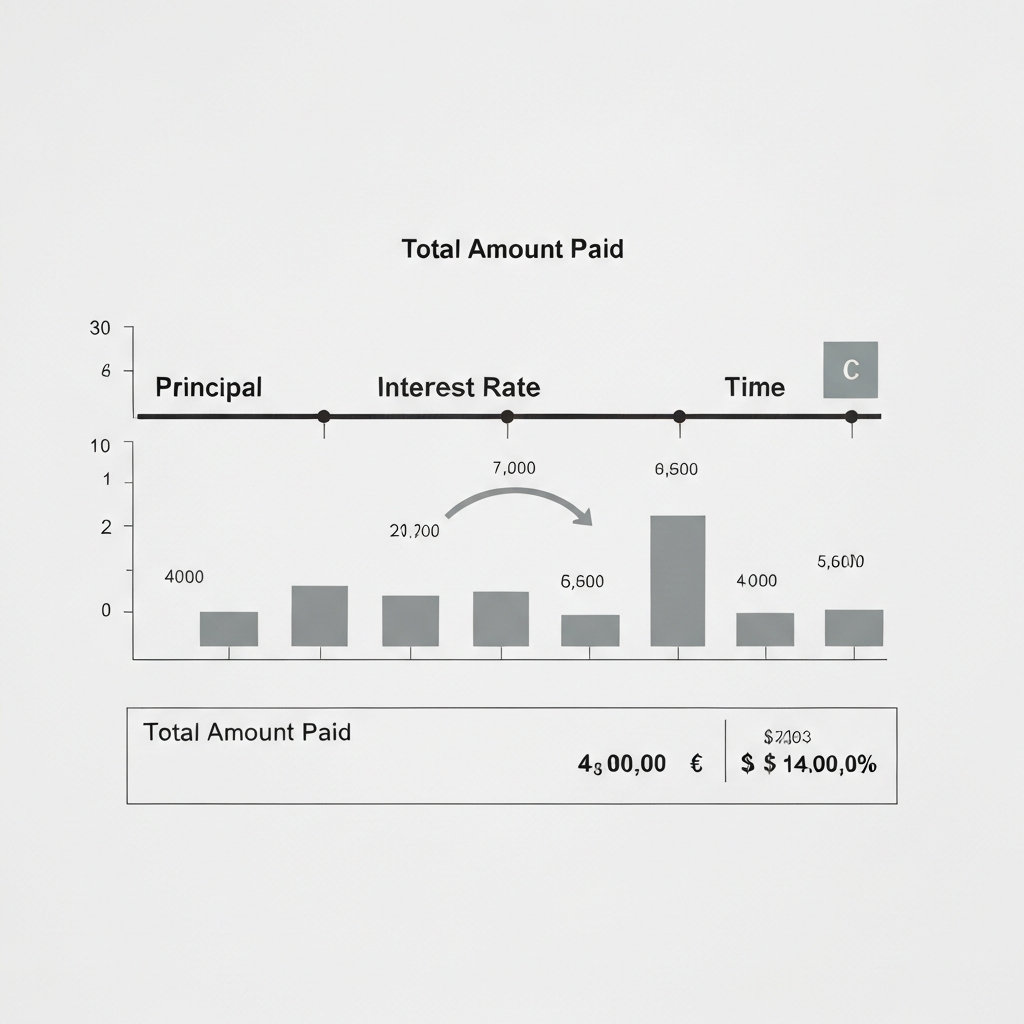
Before you can begin solving any interest rate equation, it's crucial to identify the key variables involved. These variables represent different aspects of the loan or investment, and understanding their meaning is essential for accurate calculations. The most common variables you'll encounter are: Principal (P), Interest Rate (i), Time (t), and the Total Amount Paid (A). The Principal (P) is the initial amount borrowed or invested. The Interest Rate (i) is the percentage charged or earned on the principal, expressed as a decimal (e.g., 5% is 0.05). Time (t) represents the duration of the loan or investment, typically measured in years. Finally, the Total Amount Paid (A) is the sum of the principal and the accumulated interest – the figure we're aiming to calculate.
Step 2: Choose the Correct Formula
The formula you use will depend on the type of interest being applied. For simple interest, the formula to calculate the total amount paid (A) is: A = P + (P * i * t). This formula simply adds the principal to the total interest earned (or paid). For compound interest, the calculation is more complex. A common formula for compound interest, compounded annually, is: A = P (1 + i)^t. It's important to verify the specific compound interest terms (e.g., compounded monthly, quarterly) to use the correct version of the formula. For compounding n times per year, the formula is A = P (1 + i/n)^(nt).
Step 3: Convert Interest Rate and Time to Appropriate Units
Before plugging the variables into the formula, ensure they are expressed in compatible units. The interest rate is usually given as an annual percentage, so convert it to a decimal by dividing by 100 (e.g., 7% becomes 0.07). Time must be in the same unit as the interest rate's period. If the interest rate is annual, time should be in years. If the interest rate is monthly, time should be in months. For instance, a 6-month loan with an annual interest rate would require converting the time to 0.5 years.
Step 4: Substitute the Values into the Formula
Now that you have identified the variables, chosen the correct formula, and converted the units, it's time to substitute the values into the formula. Carefully replace each variable in the formula with its corresponding numerical value. For example, if P = $1000, i = 0.05, and t = 2 years, and using simple interest, the equation becomes: A = 1000 + (1000 * 0.05 * 2).
Step 5: Perform the Calculation
With the values substituted into the formula, perform the mathematical calculation to find the total amount paid (A). Following the order of operations (PEMDAS/BODMAS), first perform any calculations within parentheses, then exponents, then multiplication and division (from left to right), and finally addition and subtraction (from left to right). In our simple interest example, A = 1000 + (1000 * 0.05 * 2) becomes A = 1000 + (100) which simplifies to A = $1100.
Step 6: Interpret the Result
The final result represents the total amount paid, including the principal and the interest. In the simple interest example above, $1100 is the total amount you would need to pay back after 2 years. Understanding how much of that total is interest is also important. In this case, $1100 - $1000 = $100 in interest. Always double-check your calculations and the units to ensure the result makes sense in the context of the problem.
Common Mistakes to Avoid
One of the most frequent errors is forgetting to convert the interest rate from a percentage to a decimal. Another common mistake is using the wrong time unit. Always double-check that the time unit matches the interest rate period. Also, carefully distinguish between simple and compound interest formulas, as using the wrong formula will lead to inaccurate results. Furthermore, be mindful of rounding errors; if the interest rate involves many decimal places, use as many decimal places as possible in your calculations to maintain accuracy until the final result, then round appropriately.
FAQ Section
Q: What is the difference between simple and compound interest?
A: Simple interest is calculated only on the principal amount, while compound interest is calculated on the principal plus accumulated interest. This means compound interest earns "interest on interest," leading to faster growth over time.
Q: How do I calculate monthly payments on a loan?
A: Calculating monthly payments involves a more complex formula that considers the loan amount, interest rate, and loan term. Online loan calculators are readily available for this purpose, or you can use financial software.
Q: What does APR mean?
A: APR stands for Annual Percentage Rate. It represents the total cost of borrowing money annually, including interest and any fees. It's a useful metric for comparing different loan offers.
Q: Can I use a spreadsheet program to calculate interest?
A: Yes, spreadsheet programs like Microsoft Excel or Google Sheets have built-in functions for calculating interest, such as the PV (Present Value), FV (Future Value), and IPMT (Interest Payment) functions. These are especially helpful for more complex scenarios like amortizing loans.
Pro Tips
Always double-check your work. Misplacing a decimal point or using the wrong formula can lead to significant errors. Utilize online interest calculators to verify your manual calculations. This can help catch any mistakes you may have made. When dealing with complex loan scenarios, consult a financial advisor. A professional can provide personalized guidance and ensure you're making informed financial decisions.
Conclusion
Calculating the total amount paid in an interest rate equation is a fundamental skill for managing your finances. By understanding the key variables, choosing the correct formula, converting the units appropriately, and performing the calculations carefully, you can accurately determine the total cost of borrowing money. Remember to double-check your work, utilize online calculators for verification, and consult a financial advisor for complex scenarios. With these tools and this knowledge, you're well-equipped to make informed financial decisions and avoid costly surprises.